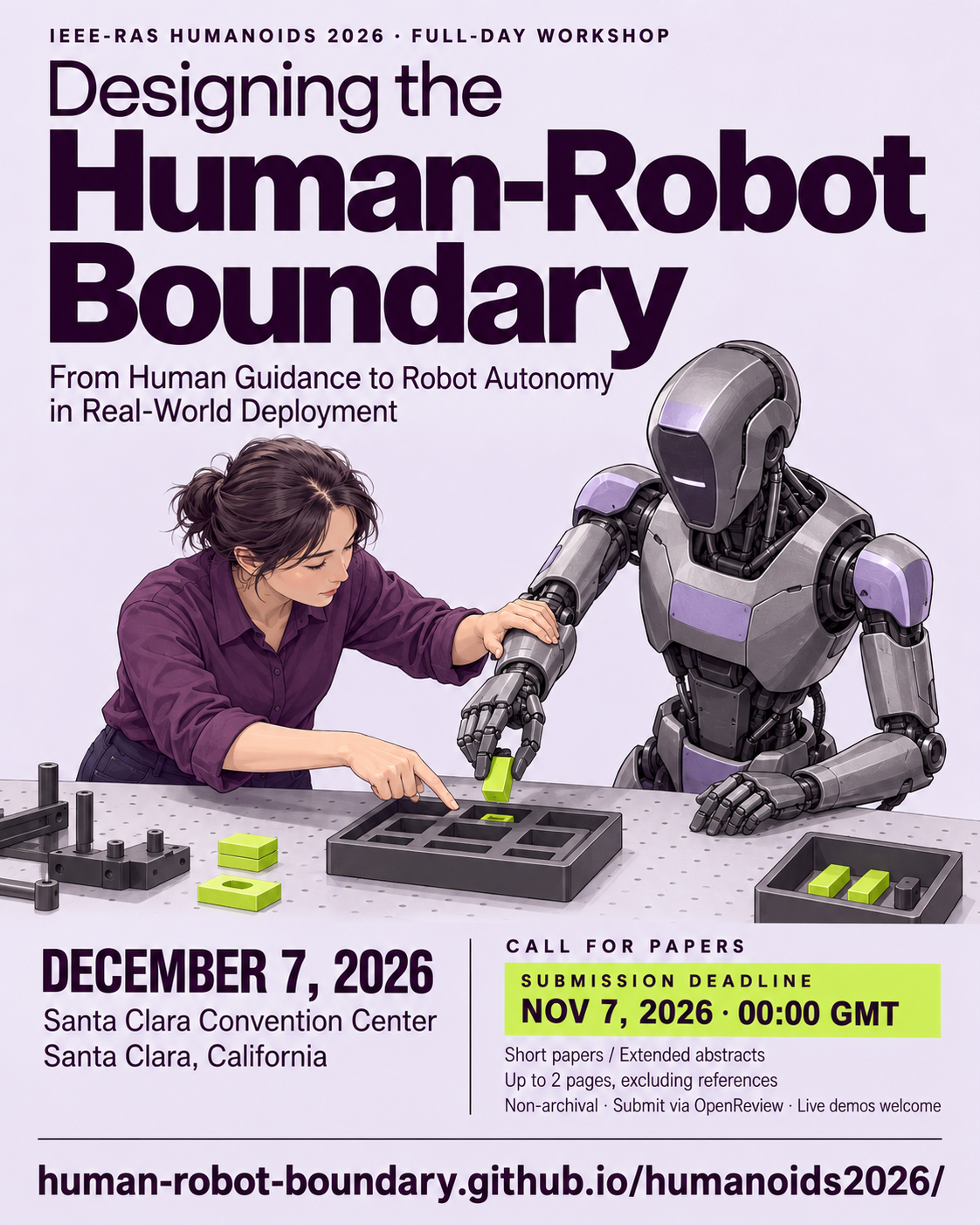
Robot learning is rapidly changing how robots acquire and execute skills, but it is also reshaping the role of humans in robotic systems. While recent advances have enabled robots to learn from demonstrations, large-scale datasets, simulation, and foundation models, reliable deployment in real-world environments remains difficult. Learned policies still face distribution shifts, ambiguous task specifications, limited failure recovery, and safety-critical edge cases. As a result, humans remain deeply involved throughout the robot learning lifecycle, including task definition, simulation and data configuration, teleoperation and demonstration collection, runtime supervision, failure intervention, and policy debugging.
This workshop will examine the evolving boundary between human guidance and robot autonomy in the current and emerging era of robot learning. Rather than viewing human intervention only as a limitation to be eliminated, we ask how human input should be represented, collected, interpreted, and integrated into learning-enabled robotic systems. This question is increasingly important as the people involved in robot deployment expand beyond expert roboticists to include system integrators, operators, domain experts, and end users.
The workshop will discuss problem formulations, technical components, interfaces, and evaluation methods for reliable human-in-the-loop robot learning. Topics of interest include task specification by non-expert users, learning from teleoperation and interventions, shared and adjustable autonomy, simulation and data-generation workflows, policy debugging, failure recovery, user-facing robot interfaces, and metrics for reliability, safety, workload, and trust. Through these discussions, the workshop aims to clarify where autonomy should end, where human guidance should enter, and how future robot learning systems should be designed around this boundary.
This workshop expects participation from researchers and developers involved in Robot Learning, robot task planning, simulators, visualization tools, and UI/UX development for robotic products. By integrating diverse expertise in robotics, simulators, computer graphics, UI/UX, and web design, this workshop aims to reconsider, from a top-down UI perspective, the research challenges that future robotics should address.